Calling Mint useless for advanced budgeting is not quite right, and getting that distinction right matters. Mint was not a bad product. It was a beginner product that most of its users eventually outgrew without realizing they had outgrown it. The app kept working. The charts kept updating. Nothing broke. So people kept using it long after it stopped telling them anything they did not already know.
That is a more uncomfortable problem than uselessness. A useless tool gets replaced. A tool that feels useful while delivering almost no real insight gets defended, depended on, and blamed when finances do not improve despite consistent engagement with it. Mint did not fail serious personal finance users. It was never designed to serve them in the first place.
The real question is not why Mint fails at advanced budgeting. It is what advanced budgeting actually requires, and why so few tools even attempt to provide it.
The Current State of Mint and Budgeting Apps
Mint is gone now. Intuit shut it down in early 2024 and pushed users toward Credit Karma, a product built around credit monitoring and financial product recommendations rather than spending analysis. The migration was not smooth. Users who had years of transaction history inside Mint found themselves with a CSV export and no clear path forward.
The response from the personal finance community was revealing. For casual users, Mint’s shutdown was an inconvenience. For the analytically-minded people who had tried to use Mint for serious analysis, it was almost a relief. It forced a question that should have been asked years earlier: why was all that financial data locked inside someone else’s app?
The budgeting app category has not changed much in response. YNAB, Copilot, Monarch Money, and a dozen smaller competitors all operate on the same fundamental model as Mint. You connect your bank. They categorize your transactions. You get a dashboard someone else designed. The data lives in their system, not yours.
For people just starting to pay attention to their finances, this model works fine. For people who want to understand their finances at a level that actually produces behavioral change and measurable wealth building, it hits a wall almost immediately.
Why the Old Thinking Fails
The budgeting app model is built on a flawed assumption: that the problem people have with their finances is a lack of summarized information. Give someone a pie chart of their spending categories and they will make better decisions. Show them their subscriptions in a list and they will cancel the ones they do not need.
This assumption is wrong for serious users, and the evidence is in the results. People who have used budgeting apps for years often cannot tell you their actual monthly burn rate. They cannot tell you whether their savings rate has improved over the past six months. They cannot tell you which spending category drifted most in the past quarter. The app has been processing their data the whole time. They just never had access to it in a form they could actually interrogate.
The problem is not motivation. It is the nature of the tool itself.
Generic budgeting apps are designed around the median user. The median user finds detailed transaction data overwhelming. So the apps simplify. They collapse nuance into categories. They surface feelings of progress rather than precise measurements of it. They are optimized for retention and engagement metrics, not for financial clarity.
When you are a serious personal finance user — someone who thinks in systems, who wants to build their own analysis, who has questions the app’s dashboard was never designed to answer — optimization for the median user is actively working against you. The simplification that helps beginners obscures the signal you are trying to find.
A Better Framework
The shift from budgeting app thinking to genuine financial clarity requires three things. They sound simple. Most tools make them nearly impossible.
First: direct access to your raw transaction data. Not a summary. Not a categorized total. The actual rows. Every transaction, with the date, amount, merchant, and description, in a format you can filter, sort, and analyze on your own terms. This is the foundation everything else depends on. Without raw data access, every insight you get is mediated by someone else’s decision about what matters.
Second: a flexible environment to build your own analysis. A fixed dashboard is someone else’s answer to what questions about your finances are worth asking. The serious personal finance user needs to be able to ask different questions as their understanding of their own finances deepens. That requires a tool that does not have opinions about what the analysis should look like.
Third: automation that removes the maintenance burden. The reason manual approaches fail is not laziness. It is that manually maintaining a financial tracking system is a part-time job. The data collection has to be automatic, consistent, and reliable, or the system degrades the moment life gets busy.
Most tools in the personal finance space solve one of these three things. Very few solve all three. ZentroData solves all three, and the difference in what becomes possible as a result is not incremental. It is categorical.
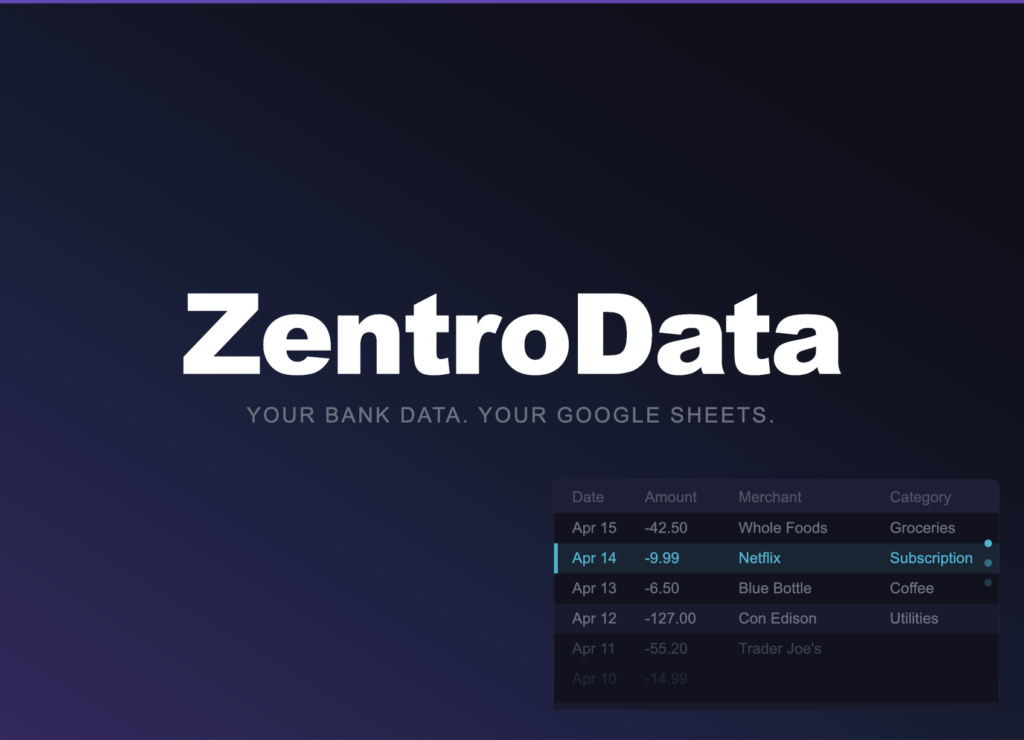
ZentroData connects directly to your bank accounts and syncs your transaction data automatically into your own Google Sheets on a schedule you set. Your raw transaction data lands in a spreadsheet you own and control, with columns for date, amount, merchant, description, category, bank, and account. Syncs run in the background daily without any input from you. There is no dashboard imposed on top of your data. There is no proprietary system you have to work within. There is a Google Sheet with your actual numbers in it, ready for whatever analysis you want to build.
That might sound like a small distinction from what Mint offered. It is not. When your data is in Google Sheets, you can write a SUMIF formula that calculates your true monthly burn rate going back 18 months. You can build a subscription tracker that shows exactly which recurring charges have increased over time. You can create a chart that shows your savings rate as a percentage of income, updated automatically every time a new sync runs. None of that was possible in Mint. None of it is possible in any app-based alternative either.
What This Means for Serious Personal Finance Users
The category of tools that actually serve analytically-minded personal finance users is much smaller than the budgeting app market would suggest. Most of what gets recommended as a Mint alternative is just Mint with a different interface. Same model, same limitations, slightly different aesthetic.
The tools worth taking seriously for advanced personal finance share one characteristic: they get your data out of a closed system and into a format you control. Google Sheets is the most powerful and accessible environment for this kind of analysis for the vast majority of people. It is flexible enough to build anything, familiar enough that most people already know how to use it, and connected enough through services like ZentroData to stay current without manual maintenance.
The contrast between what ZentroData makes possible and what Mint ever offered is stark. Mint gave you access to Mint’s analysis of your data. ZentroData gives you access to your data, full stop. The distinction sounds philosophical until you sit down with 90 days of raw transaction data in a spreadsheet you control and start asking questions the app never thought to surface. The real burn rate question. The subscription creep question. The month where everything went sideways and why. The pattern that has been hiding in the numbers for two years that you never saw because you were looking at a pie chart instead of the data behind it.
Mint Useless for Advanced Budgeting: A Comparison
| Approach | Data Access | Custom Analysis | Automation | Best For |
|---|---|---|---|---|
| Mint (discontinued) | None | None | Yes | Beginners, passive tracking |
| Budgeting apps (YNAB, Copilot, etc.) | Limited export | None | Yes | Methodology-driven beginners |
| Manual CSV exports | Full | Full | No | People who start strong and burn out |
| ZentroData + Google Sheets | Full | Full | Yes | Serious analysis without maintenance burden |
The table above makes the gap obvious. Manual CSV exports give you full data access and full flexibility, but no automation. Budgeting apps give you automation but no real data access or flexibility. ZentroData is the only approach that delivers all three, which is why there is no meaningful comparison between what it enables and what any app-based alternative offers.
Frequently Asked Questions About Mint and Advanced Budgeting
Q: Was Mint actually useless, or just limited? A: Limited is more accurate. Mint worked well for what it was designed to do: give financially unengaged people a passive, low-effort view of their spending. For users who wanted more, it was not useless so much as it was a ceiling. It processed your data without ever giving you access to it, which meant the analysis never went deeper than what Mint’s dashboard was built to show.
Q: What did Mint get wrong about personal finance? A: Mint assumed that summarized information was what users needed. For most users, most of the time, that assumption was correct. For serious users, it missed the point entirely. The value in financial data is not the summary. It is the ability to ask your own questions of your own numbers and get precise answers. Mint never made that possible.
Q: Why do budgeting apps keep using the same model if it does not work for advanced users? A: Because it works for the majority of users, at least at a surface level. The budgeting app market is built around acquisition and retention of a broad user base. Advanced users are a small segment. Building for them would require a fundamentally different product that would be less accessible to the majority. Most companies make the rational business decision to optimize for the median user.
Q: Is Google Sheets actually a good personal finance tool? A: Google Sheets is one of the most powerful personal finance tools available, with one significant limitation: it has no native bank connection. The analysis it enables, once you have transaction data to work with, is more flexible and more powerful than anything a dedicated budgeting app offers. The question is how you get the data in. ZentroData solves that problem specifically, which is why the combination of ZentroData and Google Sheets outperforms any standalone budgeting app for serious personal finance use.
Q: What can you do in Google Sheets that you cannot do in Mint or a budgeting app? A: Build your own burn rate chart from raw transaction data. Write a formula that calculates your savings rate as a percentage of income across any time period you choose. Create a subscription audit that flags every recurring charge above a threshold you set. Build a month-over-month comparison for any spending category going back as far as your data runs. Ask any question about your finances that you want an answer to, and get a precise numerical answer rather than a simplified app summary. None of this is possible in Mint or any app-based alternative.
Q: How is ZentroData different from just downloading CSVs from your bank? A: CSV downloads give you data access but require constant manual effort: downloading files, cleaning inconsistent formatting across banks, merging months without creating duplicates, and repeating the entire process every month indefinitely. ZentroData automates the entire pipeline. Your transaction data arrives in Google Sheets automatically, in a consistent structured format, with deduplication handled by a unique transaction ID. The data access is identical. The maintenance burden is eliminated entirely.
The Real Problem Was Never the App
Mint was not useless. It was a product designed for a specific kind of user, and for that user it worked reasonably well for a long time. The problem for serious personal finance users was not that Mint failed. It was that they kept using it past the point where it had anything useful left to show them.
The most expensive financial tool is the one that makes you feel informed while keeping you in the dark about the numbers that actually matter. That is not a Mint problem specifically. It is the defining characteristic of every closed budgeting app, and switching between them changes nothing of substance. The only thing that changes the analysis is changing what you have access to.
Related posts:
 How To Track Credit Card Spending In Google Sheets In Under 1 Minute And Never Manually Export Transactions Again
 How Do I Get My Bank Transactions into Google Sheets Automatically?
What Is the Best Way to Automatically Import Bank Transactions into Google Sheets?
How to Track All Subscriptions in One Place
How Do I Get My Bank Transactions into Google Sheets Automatically?
What Is the Best Way to Automatically Import Bank Transactions into Google Sheets?
How to Track All Subscriptions in One Place