Running out of money before the month ends is almost always a visibility problem, not an income problem. Most people have no accurate, current picture of where their money is going between paychecks. When you cannot see your spending in real time, you cannot course-correct before the damage is done. By the time the pattern becomes obvious, the month is already over.
The fix is not a budget. It is data. Specifically, it is knowing your actual numbers on an ongoing basis, not guessing based on a rough mental model that resets every 30 days.
Why This Matters
The gap between what people think they spend and what they actually spend is almost always larger than expected. Subscriptions they forgot about. Dining out that feels occasional but adds up to $400 a month. Small recurring charges that individually seem irrelevant but collectively represent a slow, steady bleed.
When you run out of money before the month ends, one of three things is happening. Your income genuinely does not cover your expenses at the lifestyle you are living. Your spending is fine on average but inconsistent, heavy in the first half of the month and painful by the end. Or you have hidden spending you have not accounted for because you have never actually looked at the data closely enough to find it.
Most people, when they look at the real numbers, find all three.
How It Works
The mechanics of running out of money before month-end follow a predictable pattern. Expenses are not evenly distributed across the month. Rent or mortgage hits on the first. Subscriptions cluster around the same dates every month. Irregular spending, eating out, entertainment, and impulse purchases, fills in the gaps unpredictably.
Without a real-time view of where you stand, every spending decision happens in the dark. You spend based on how much you feel you have, not how much you actually have after accounting for what is still coming. That feeling is almost always optimistic. The result is a shortfall that feels like a surprise every single month, even though it is the same pattern repeating.
What Actually Fixes It
The only thing that reliably solves this is replacing the mental model with real data. Here is what that looks like in practice:
- Know your fixed monthly outflow. Add up every recurring charge: rent, subscriptions, loan payments, insurance. This number does not change month to month and most people underestimate it by 20 to 30 percent because they have never actually totaled it.
- Track your variable spending in real time. Not at the end of the month. During the month, while you can still change your behavior. A week-three check-in on where you stand is the difference between catching a problem and explaining it after the fact.
- Find your burn rate. Your burn rate is the total amount of money leaving your accounts each month, fixed and variable combined. Most people do not know this number precisely. Once you do, you stop running out of money by accident.
- Identify the hidden spending. Subscriptions you forgot you signed up for. Services being charged to a card you rarely check. Recurring fees that stopped delivering value two years ago. This category alone often accounts for $100 to $300 per month for people who have never audited it.
The most practical way to do all of this is to get your actual bank transaction data into a spreadsheet and look at it. Not a summary in an app. Not a pie chart someone else built. Your raw numbers, in a format you can sort, filter, and analyze on your own terms.
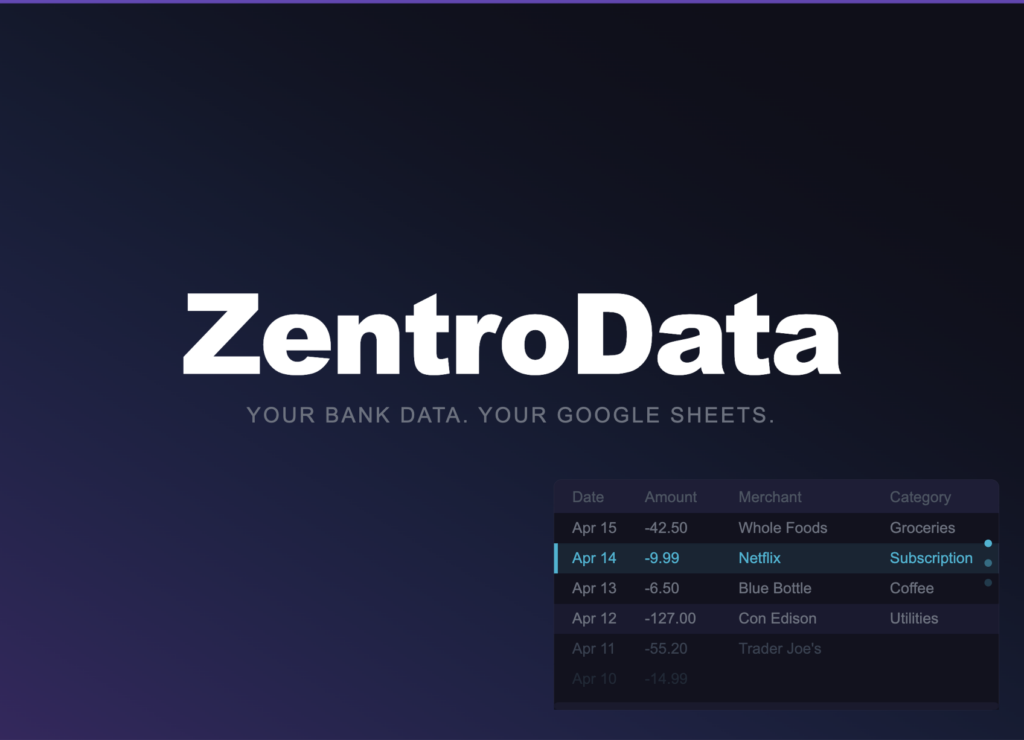
ZentroData does exactly this. It connects to your bank accounts and syncs your transaction data automatically into your own Google Sheets, with starter templates for burn rate tracking, subscription detection, and spending breakdowns. Once your data is in a spreadsheet you control, the patterns that have been draining your account every month become impossible to ignore. You can find out more at zentrodata.com.
What to Watch Out For
- Budgets without data fail. Setting a budget based on what you think you spend, rather than what you actually spend, is a guess. Guesses do not hold. Start with the real numbers, then build the budget around them.
- App summaries are not enough. Generic finance apps show simplified category totals. They are designed to make you feel informed, not to show you the truth. Real analysis requires access to the raw transaction data, not a curated summary of it.
- One month of data is not enough. Spending patterns vary significantly month to month. Three months of data gives you a baseline. Six months shows you the real pattern. A single month snapshot leads to decisions based on an unrepresentative sample.
- Subscription creep is real and silent. Subscriptions do not feel like spending because they do not require a decision each month. They are invisible by design. Auditing your recurring charges once a quarter is not optional if you want an accurate picture of your outflow.
Frequently Asked Questions About Running Out of Money
Q: Is running out of money before month-end always a budgeting problem? A: Not always. It is more often a visibility problem. People who run out of money before the month ends frequently have sufficient income but no real-time awareness of where it is going. Budgeting without accurate data is guessing with extra steps. The first step is understanding what you actually spend, not setting targets before you know the baseline.
Q: What is a burn rate and how does it help? A: A burn rate is the total amount of money leaving your accounts in a given month, fixed and variable expenses combined. Knowing your burn rate precisely tells you how much runway you have at any point in the month. When your burn rate exceeds your income, the shortfall is predictable. When you know the number, you can act on it before the month ends rather than after.
Q: Why do budgeting apps not solve this problem? A: Most budgeting apps show simplified summaries built around their own category systems. They are designed for broad financial awareness, not detailed analysis. If your categories do not match how you think about your spending, or if you want to build custom views across multiple accounts, generic app summaries are not enough. Owning your raw transaction data in a spreadsheet gives you the flexibility those apps do not.
Q: How do I find out what subscriptions I am actually paying for? A: Pull your last 90 days of bank and credit card transactions and look for any charge that repeats on a monthly or annual basis at a similar amount. Services like ZentroData automatically flag recurring charges from known subscription merchants and pattern-match others based on frequency and amount. A single audit of this kind regularly surfaces $100 or more in charges people had forgotten about entirely.
Q: How many months of transaction data do I need before I can see a real pattern? A: Three months gives you a working baseline. Six months is more reliable, especially if your spending varies seasonally or if you had unusual expenses in any given month. The more data you have, the clearer the pattern becomes, and the harder it is to explain away the numbers with one-off exceptions.
The Real Problem Is Not Willpower
Running out of money before the end of the month is not a discipline problem. It is a data problem. The people who consistently live within their means are not more self-controlled — they just know their numbers.